Thursday, April 3, 2008

More Falkland Islands Fun!

YOUR CORRESPONDENT DOES THE WRONG THING:
WHY DOES IT FEEL SO GOOD TO BE AN IMPERIALIST? 
Residence GardenAmbassador's Residence
Answer: Because you get to live here.

Being the insensitive type that I am, I may have posted some things in this blog that shed a less than charitable light on Argentina's obsession with the Falklands. I'd like to point out that I wrote all those things before I got invited to spend a little time last night over at the British embassy here in Buenos Aires.

The tiny shred of decency left to me prevents me from describing the wild party we had on Argentina's big day of mourning, but I will say it was a good time had by all (except the riot police out front protecting the building). The house is beautiful, and apparently the most secure building in the entire country. I imagine that our embassy is more secure, or at least uglier, but the fact was recounted to me with such pride, that I'll simply have to agree.

I didn't really see any security guards, but walking through the house I was always nervous that some SAS types might jump out and mistake me for some kind of SPECTRE goon. The house is full of antiques and fine art, but what really jumped out at me were all the pictures of the Queen. I suppose I would have expected a little variety, but they were all pictures of the reigning monarch. There is one spot I noticed where I could see at least four pictures of  Her Majesty (three paintings and a coronation photograph). The picture that confronts you going up the main stairs of a slightly larger than life Queen Elizabeth II is particularly impressive.

ASIDE: How much of the Queen's time is taken up by having her portraits painted ad nauseam for all the embassies around the world? Judging by this place, it's probably a lot. It's good to stay busy.

When I got the invitation I couldn't say no. Not just because it was the most cruelly ironic way to have a good time, but because I'd finally have the chance to see up close something that I'd only read about in books: blue-blooded English people. It was certainly a good time, but things have come a long way from the Bertie Wooster days. 
Dramatization: Your correspondent enjoying a postprandial Turkish at the Embassy.
The girls certainly looked a bit thin, anyway. I think they must have been on some special diet. Maybe they'd all just been sick, as they seemed to be disappearing off to the bathroom and sniffling all night. Poor creatures; I wish them a speedy recovery.  

All the Englishmen I met there seemed interested in telling me all about their "Gap Year," some kind of rite of passage for the young and upwardly mobile over in their country. All of them seemed to be traveling straight across the southern half of the planet: Argentina, Brazil, Chile, Fiji, New Zealand, Indonesia, Thailand, Goa, et cetera.  Sounds like a nice way to pass the time, but my life is enough of a Gap Year already, so I'll stay in Buenos Aires for now. 

Most of them seemed pretty surprised to discover that it was the worst day of the year to be English in Argentina, even though there was also a good splattering of Argentines at the party as well. To most of them, Buenos Aires was just one stop on their world party tours. The club going enthusiasts seemed to think that Buenos Aires is the best city in the world for that sort of thing, and a few had decided to extended their stays for a few weeks (just skip Patagonia or Bolivia). By and large, though, I didn't really get the impression from the ones who planned on staying  that they knew what the holiday was about. Having found the most English-friendly party in town, I doubt they cared too much.

I wish I could provide some profound insight about how this most sacrilegious of parties is a perfect demonstration of the way money and first world privilege insulate people from reality. Unfortunately, I was just as separated from reality by the ambassador's wet bar as I was by money, privilege or federal riot police, so the story will just have to wait. 

Wednesday, April 2, 2008

FUN FACTS ABOUT THE FALKLANDS - SPECIAL MALVINAS DAY EXTRA


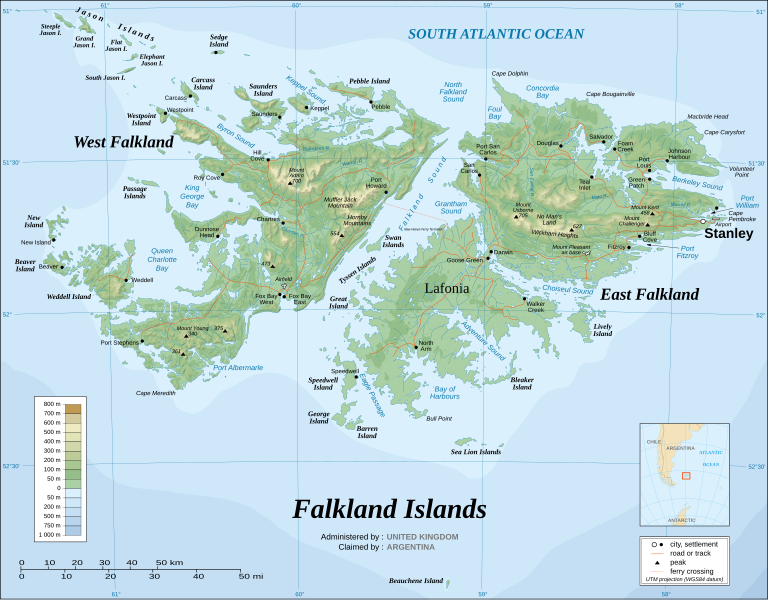
Today as Argentine's celebrate Malvinas Argentinas day, I thought I'd like to share with you some fun facts about the reason everything in the country is closed today and about the cold political (mis)calculations that led up to Argentina deciding to exercise its claims to sovereignty over the islands.

Did you know?
  • That the Falkland Islands number one export is soul crushing boredom?                   Wildlife holidays in The Falkland Islands - Southern Elephant Seal by Will Wagstaff
  • That in only 90 hours you too could visit the Falklands from anywhere in the world (except Argentina)? 
  • That the the Falkland Islands are actually the secret island headquarters of the Legion of Doom? 
  • That the Falkland Islands are the most politically expedient place in Argentina?
The war for the Falklands was one of the largest blunders in history. The Junta thought that an easy victory in the largely undefended islands would distract the population from their gross incompetence and their atrocious human rights abuses. They failed to take into account that Baroness Thatcher had the same problems and bigger balls. 


It takes a man to wear pink. Happy Malvinas Argentinas Day!


"I HAVE ANOTHER SIN - BEING A WOMAN" - C. F. de K.

MEAT STRIKE: DAY 21

"To the client: We inform you that for reasons beyond the control of this business, we find ourselves with a deficiency of meat products"

First off, allow me to wish all my readers a very happy Argentine Malvinas Islands day. In the grand tradition of politics in this country, yesterday President Cristina Fernandez de Kirchner reaffirmed Argentina's inalienable sovereignty  over the tiny, sheep-rich islands just as she managed to send the country straight to hell with a 40 percent tax increase on soy exports. Although global prices for agrarian exports are at their highest level in years in years, La Presidenta's glorious leadership has resulted in a general strike across the farm industry. Gauchos are burning bails of hay on the highways at roadblocks every few miles to prevent any agrarian products from going anywhere, and millions of cows, pigs, sheep and chicken are enjoying a stay of execution. Instead of enjoying an enormous influx of foreign currency, the country is at a complete standstill. 

Why are these Gauchos enjoying an afternoon drive instead of killing me some steaks?
More pressing to me than the fate of the country, though, is that there is no meat anywhere. I don't want to say that I came here to eat steak, but I certainly didn't come here to not eat steak. Rather large numbers of the locals seem upset as well, and protests have taken place all over the city. Unfortunately, these protests have gone from extremely annoying to violent in a rather short span of time. It began with large middle class protests against the government that saw thousands taking to the street (or simply hanging out the windows) banging pots and pans. I was willing to endure this cacophonic outburst of popular sentiment as I thought that the nonstop clanking might encourage the government to reconsider is position.  The Peronists, however,  already know that they do not enjoy major support in the capital, and have decided to play to their base by not appearing weak in front of the effete citizens of Buenos Aires. Instead, Kirchner's government has brought in the nations number one rabble-rouser to create the appearance of grassroots support by whipping up a mob. Some of the counter demonstrations organized by Luis D'Elía (pictured below) have already erupted into brawls, largely ignored by the federal police.  

Mr. D'Elía supplies thoughtful commentary to representatives of the fourth estate.
To a crowd of thousands bused in from the slums and suburbs of the city, La Presidenta delivered an impassioned speech about how the nebulous and fascistic powers behind the current strike have conspired to undermine her government because they fear the mob (not Cristina's words) and because she is a woman. Then, in a masterstroke of political double or triplethink, she changed the topic from the present situation paralyzing the country to the 1976 military coup and then on to Argentina's specious claim to the windswept Falkland Islands.  
 La Presidenta opens the roads with ruthless efficiency. 
Allow me to attempt to enter the mind of her excellency: This strike is being perpetrated against me by fascists because I am a woman, these same fascists are responsible for the last coup, the fascists want to keep the country weak, the country needs the Falkland Islands, do not look at the man behind the curtain. That the 1976 coup just so happened to oust the other woman president to occupy the Pink House allows Cristina to distract the audience from the issue of the unjust tax increase and create sympathy for herself by portraying herself not only as the victim of sexism, but also by assuming the unassailable mantle of a martyr of the dictatorship.

Instead of focusing on the government's exorbitant tax hike on small farmers, the audience is left with the impression that Cristina - sanctified by the blood shed in the dirty war - is defending the country from the criminals of the oligarchy. That the claim to the Falklands was by and large manufactured by these same criminals (Nicolás Francomano himself, probably) when their own incompetence was becoming readily apparent matters little. Even though it was the fascists whom Kirchner decries that had the idea to invade the Falklands in the first place, the president seems content to manipulate the mob with the feverish sloganeering of irredentism rather than addressing the problems she has created. 

All things being equal, I suppose that this sort of political duplicity exists in every country of the world (except in Scandinavia), and that Argentina is still better off with Peronism's duplicity than Bolivarian Socialism's totalitarian inclinations. Maybe someday they will get the Falkland's back, but until then I'd like somebody to do something about the steak situation.


Wednesday, March 26, 2008

NICOLAS FRANCOMANO ESTA MUERTO

I am still quite alive (I even had my hair cut to celebrate), but Nicolás Francomano, my Argentine doppelgänger, may have suffered some unspeakable fate. You see, recently I took it upon myself to locate whatever distant relations I may have in this country. There are several Francomanos listed in the Buenos Aires white pages, a few of whom received unexpected calls from yours truly this monday past. Alberto J. and Alfredo M. Francomano no longer reside at the listed numbers, so the first person with whom I managed to speak was a Señor Francisco Francomano. 

Imagine my surprise to discover that in this city there is a man with nearly the exact same name as my own father. One discovers that the farther he travels, the world only seems to grow smaller and smaller. This Francisco Francomano was a very nice sort of man, and he gave a nice little laugh when I told him that I believe myself to be his very distant cousin from America. He was quite surprised as well to discover that he and my father share a name, by the way. I left him with my number, not to push the point about making contact with me, to call at his discretion about any possible meeting (or reunion, as I like to think of it). I am, as it were, a complete stranger to this end of the gene pool.

Being a stranger, I was made to feel somewhat strange by the other Francomanos with whom I spoke that monday. The next number I called belongs to a Monica B. Francomano, a woman whom I presume to be of a certain caducity. I informed her, as I had informed Francisco, that I was Nicolás Francomano, her cousin from America. I generally introduce myself this way in Spanish, as I find the Spanish "Nicolás" close enough to our own Anglo "Nicholas" that the same understanding is preserved (no so in the case of a William/Guillermo, for example), and native speakers are not inconvenienced by pronouncing my English name. The confusion that ensued in this instance, however, was brief but remarkable. 

"Don't lie. You are not Nicolás Francomano!" A point I might have justly conceded, in hindsight.
"I am, I think I am your cousin from America."
"Must you invent such things?" 
"I invent nothing, ma'am."
A profound silence met this remark. Then, Daniel O. Francomano picked up the phone. I decided not to ask his relation to Monica. According to what he told me, he has several older cousins. He made no mention of a younger generation of Argentine Francomanos, and seemed somewhat surprised by my own relative youth. Also, he claimed not to know Francisco. Otherwise he seemed pleasant. I gave him my number, and he said that he would call me in order to meet this week. He has not called me yet.

The last one of my list that I was able to reach over the telephone was Martha J. Francomano. Martha received news of her distant relation's appearance rather coldly, to say the least. Interestingly, though, when I told her that I was Nicolás Francomano she too seemed perplexed. She asked me, after a short pause, whether I meant to say that I was Nicolás Francomano's son. When I explained to her that I was he himself, and that I was from the United States, she was nonplussed. She regarded me with a very obvious species of mistrust, as if I were calling her in order to initiate some elaborate swindle. In the middle of me trying to explain that I merely wanted to contact her out of curiosity, she told me that she did not have what I was looking for and hung up.

Needless to say, this frustrated me inestimably. I was left, however, with more to the mystery of my doppelgänger. In my idle moments, I developed a few theories concerning this mysterious man.

WHO IS NICOLAS FRANCOMANO?
  1. Nicolás Francomano is dead. The Argentine Francomanos want nothing to do with me because my appearance in their lives will spur the resurfacing of terrible, terrible memories.
  2. Nicolás Francomano is (or was) in prison for Crimes Against Humanity.  He is a pariah because the family cannot bear the shame of having their illustrious name associated with his despicable crimes.
  3. Nicolás Francomano became involved in organized crime outside of the country. This explains how Martha didn't seem surprised when I said I was from America; she merely assumed that I had been born there and raised on the spoils of Nicolás Francomano Sr.'s criminal empire. 
  4. All of the above. Martha never expressly mentioned that she was related to Daniel and Monica, and therefore Nicolás Francomano may in fact be two (three counting myself) people. Also, 2 and 3 do not exclude option 1, and do not in fact even exclude each other.

LIFE IS A MYSTERY

Sunday, March 23, 2008

SOME MORE PHOTOGRAPHS

More photographs, these taken around the barrio of Palermo.
Suggestive ice-pop, traditional mansion.
Organic pizza - it's delicious.
I'll have another slice, please.
Tayler at the Oldest House in Palermo.
Running is a wonderful way to stay healthy.
Street art. 
New neighbors.
Participating in global culture.
Nighttime.
More street art.
Hardware store.

WHO IS GAUCHITO GIL?


Your correspondent at a shrine to the popular saint known as Gauchito Gil

The altars to the folk hero and popular saint known as Gauchito Gil are hard to miss. The faithful paint them bright red, fly red flags, leave red wine, marlboros and roses. A shrine to Gil on the Pampa is a bright spot on the immense open plain. But who is Gauchito Gil? How did a simple Gaucho come to be venerated as a saint across the entire country? 
Gauchito Gil is, of course, first and foremost a gaucho. It is not difficult for me to imagine a doctoral thesis gathering dust in the library of the University of Buenos Aires, "Gauchito Gil as Homo Faber: Proletarian Ideology in Argentine Popular Religion." He was a simple countryman from the province of Corrientes, though, and most likely never got around to reading Arendt or Frisch. He most likely would have received his education from the fiery songs of the traveling payador (traditional Gaucho minstrel). Given this upbringing in the folklore of love, loss, betrayal and bloodshed, it seems appropriate that the story of Gauchito Gil's life begins with a star crossed love between the humble Gaucho and a beautiful widow. 
The widow's brothers, little pleased with the rumors circulating in the small town of Pay Ubre regarding late night serenades and other such latin follies, decided that Gauchito Gil had become an unacceptable nuisance. The brothers gathered up the decent citizens of the town and put Gauchito Gil to the chase. He escaped by the skin of his teeth, disguising himself in the rawhide of a young calf and roaming out of town after dark. 


Gauchito Gil serves with distinction (bottom right)
Unable to return to his natal lands, he decided to join the Army of the republic and fight in the wars against the Paraguayans. Gauchos take naturally to warfare, given their hearty constitutions and penchant for violence, and Gil served with distinction in a Gaucho army. At the battle of Tuyutí,  Gil's battalion was ambushed by a group of elite Paraguayan indian scouts. As the other soldiers in of the unit were on the point of turning and running in the face of Paraguayan savagery, Gauchito Gil wiped the blood from the blade of his dagger and used it to signal General Mitre that the flank was about to crumble. He then animated the retreating soldiers to stand and fight until the reinforcements arrived. Thirteen thousand Paraguayans died at Tuyutí.
Needless to say, Gauchito Gil returned to the village in triumph, the opinion of the townsfolk regarding him being considerably swayed by the row of medals across his chest. He was able to resume his affair with the lovely widow, but their affair was cut short again by the scheming of the brothers. In spite of Gauchito Gil's exemplary conduct on the field of battle, and the inestimable service he had rendered to the fatherland, the brothers could not bear the sight of the peasant with their widowed sister. They conspired to have Gil drafted into service again, this time in the Federalist Army of the future dictator Rosas. 

Note the red sash - the color of the federalists would become part of the symbolism of Gauchito Gil
Gauchito Gil was no stranger to bloodshed after his service in the Paraguayan War, but the violence of the civil war was simply too much for him. After months of constant bloody skirmishes, Gauchito Gil had had enough. He had reached the breaking point, and when pushed to fight again he just snapped. Versions of the story differ, but all agree that Gauchito Gil stripped all his clothes, killed his horse and anointed himself in the blood, covering himself from head to foot. "Here is your federalist uniform!" he is reported to have screamed before running off onto the Pampa. 
No one knows what happened to Gauchito Gil during the months that he was pursued across the countryside. When they found him the horse's blood had dried onto his skin. He had tamed a wild stallion and rode him without saddle or tack. The Federalistas chased him into the desert until he collapsed from the exhaustion of riding naked without food or drink under the hot sun of the blazing Chaco. As they hanged him by his ankles from the branches of the only tree around for miles, Gil began to speak to one of his tormentors.
"You do not know, but your only son is very sick. If you bring me to him, I will heal him."
"Your fate is to die a  traitor's death here, Gil," the Federalista replied.
"Very well, but when I am dead, pray to me that the boy might live."
They left him there to die, but that Federalista did discover his child to be sick. He prayed as Gauchito Gil had instructed, and surely enough the boy was healed. The body of Gauchito Gil was cut down and properly entombed, and the story of his miracle spread across the country. Today, the devoted travel from shrine to shrine, carrying some red object as a symbol of their promises to god. 


Monday, March 17, 2008

Unofficial Hiatus Now Over

YOUR HUMBLE CORRESPONDENT OFFERS HIS APOLOGIES:
My faithful readers will no doubt have noticed that it has been some time since I attended to this blog. In the hopes that they can forgive this prolonged absence I offer up the excuse of having been torn away from the maintenance of my travelogue by the distractions of domestic companionship. What of these lost weeks, though? When last I left you, gentle reader, Tayler and I had only just arrived in this large and strange country. Surely, you must imagine, that in a land so fruitful with opportunity as Argentina, I would have engaged in gripping adventures. Is it not for first hand accounts of my sojourns in foreign lands that you even seek to turn to my words? 

I can offer you only so many words. Shamefully I allowed the time to pass me by, and now I have only the most fleeting recollections of my stay here up to this point. I will attempt to provide some background on the photos that I am able to supply to this website, otherwise I should let the images speak for themselves.

COLONIA DEL SACRAMENTO, MONTEVIDEO, URUGUAY:


Our lodging in Colonia was more than adequate. We stayed in two different places, because the website I used to book my reservation did not send it through to the hotel pictured above. They only had a room free for one night. There are no pictures of the other hotel, but I assure you it was very nice. Please note that in the second picture you see me pricking my finger on an extremely rare species of cactus, native to the River Plate area. 


Colonia is famous for its perfectly preserved colonial old town.  Founded by the Portuguese in the early 16th century, it is one of the oldest European settlements on the entire continent. The ghosts of yesterday haunt the quaint cobblestone streets of the town, the erie still of the dilapidated city is pregnant with the hushed voices of countless past generations.  Naturally the optimum means of conveyance in such an  atmosphere of living history is the "Go-Kart" or "Buggy," which can be rented for very economical prices from many reputable local businesses. These thrifty gentlemen pass the savings on to the customer by avoiding unnecessary frills (which have, inexplicably, become the fashion in our own country) such as seat-belts or wind-screens. 

Behind me in this photograph one sees the old Plaza de Toros, now abandoned. The Uruguayans, being a fairly civilized bunch, no longer practice the ancient sport of Bullfighting. On occasion the locals are known to get their blood up (being so disposed by their largely Iberian background) over matters of the heart, and the sand of the arena is considered the ideal stage for these personal dramas to conclude in bloodshed.

Colonia and it's surroundings have fantastic charm, although it can often prove quite difficult to discern where one is ever actually going. Here Tayler decides against asking the local in the background for directions and consults her map instead. 

Eventually, of course, we did arrive at the magnificent Playa Ferranda, on the River Plate. This humble establishment serves a very fine array of barbecued items and beverages of both local and international provenance.
 
Here I, taking my inspiration from the great Díaz de Solís himself, claim the beach, much as that illustrious Spaniard must have done before being savagely consumed alive by the locals.

I am pointing towards Buenos Aires, 220 kilometers away in this picture, on the other side of the river. I should at this point note that Tayler has elected not to have any of her swimsuit shots appear on this portion of the website.

How sad we were to be leaving beautiful Colonia, Uruguay, back to the hustle and Bustle of Buenos Aires. I see now that this entry has grown long and ungainly, and I will be sure to make another soon. Eventually I plan to actually bring the blog up to date, nearly in synch with the present moment at every moment.